sometimes my torch stops firing in the middle of a job… How can i restart it at a particular point - i have tried to pause it and restart it too but these never seems to work - how is the best way to paus and restart and how can i get back to a particular line of code and start at that point…
Thanks
You enter the line number in the field for that and click start or next line button and then alt-r to start.
If the torch was on and went out you’ll want to hit F5 to restart it before alt-r as there won’t be a torch on command in the code where you’re restarting.
It’s been a while since I’ve done it, but I find it works best if you scroll back in the code to the line just before the last “M3” (Torch Fire). Make sure you have pressed “STOP” if you used “Feed Hold” to stop after the torch stopped firing. Once the line is highlighted, click “Run From Here” then “Cycle start”. (I am 78.5% sure this is how to do it)
I am able to go to the line and restart however, I am getting a torch on while the torch moves to position and its etching across my project… any Ideas what I need to do to keep this from happening… The problem I think I am having with needing to stop is air flow - compressor not keeping up - though I am running about 50psi and that should be about 4cfm utilized - my compressor is 3.5 cfm at 90s and should be over 4cfm at 50psi… so I am unsure why its not keeping up… it has a small 4 gallon tank but 2hp and 3.5 cfm is on the high-end for portable compressors. anyone dealing with airflow requirements.?
F5 is a toggle - torch on/off. You’ll see it (even if it’s not actually firing because it lost the arc) on the Mach 3 panel where it says Torch. the bar will be green if it’s in firing condition, red if it’s not. Make sure it’s red before restarting the file.
That’s too small. Most torches look for something like 75-80psi and 6-8cfm. A bigger tank (like 60gal) will help make up for lower CFM ratings but the small tank combined with low pressure & low CFM ratings on yours is compounding the problem.
A few other tricks I use are:
You can edit the gcode to just include the pieces of your cut file which are left
You can go back into fusion360 and re-make your cut file and move the start point to just before/after where the torch flamed out
I think if you have a paid version of Mach3 (I’m still using demo) you can run your cut in reverse - which might allow you to cut backwards and then just crash stop once you have cut back around to where the torch flamed out initially
I hope I understood your question properly…
If I need to pause the program and jog the torch out of the way, here’s what I do to restart it:
- Reset the G code program. Click on the G code display window and then use the scroll buttons scroll down through the program.
- As you scroll through the code you’ll notice that the lines of your part that are represented by the highlighted line of code are shown in the graphic display on the right hand side of the screen. keep scrolling until you find the starting point of the first loop that has not yet been cut.
- Go back to the G code display window and you should be able to scroll up a few lines and find a G code line with an M03. Scroll up one line before that to the line that has a G00.
- Click the ‘Run from Here’ button. You should be presented with a window that asks if you consent to a preparation move. Hit yes, then cycle start. Your program should continue running right where you want to.
Pretty simple. I did this writeup from memory since I am not currently at a computer with Mach3 loaded so let me know if theres some tweaks needed!
2 Likes
I am using a smaller tip 30 amp - and I was reading for my torch that this should operate at about 40-50 psi and even the largest amp and nozzles for my machine were running not more than 60-65psi – on the chart… and the cutter is listed at 5cfm at 60 amps… so I doubt running a 30 amp nozzle running about 27 amps… requires… more than 4 cfm… my compressor is rated at 4.4 at 40cfm… and I understand if backs up a bit after a couple minutes of cutting… but it backs up… the second the machine goes on - I do have small air leak in the coupling - perhaps its taking more air than I thought……… perhaps as much as half.
What kind of cutter are you using? Maybe someone else who has the same machine can weigh in since your settings are not the same as the machines most folks are using here.
I am going by the manual. I know a lot of people want to blow 80 psi but everything I have read - most of the time people are blowing too much psi… 70 psi is like a maximum. and I agree most will perform best close to this - but I think you can cut well at 50 psi too I am using a primeweld cut 60 . It has about an average air consumption - there are some cutter closer to 4… most are in the 4-5 range. only ones I see more than this are the razorweld which have an unusually high air consumption… around 6cfm
I run 80 psi at the tank outlet for my Razorweld 45 - it drops about 5psi in the 50’ of hose between the tank and the cutter.
My Powermax 45 requires 90psi and 6cfm.
I do think there are other folks here with a Primeweld Cut 60 so maybe they can help. If you search on Primeweld you’ll find a handful or two topics pop up and see if what they’ve got helps.
Again, as I mentioned I am leaking at the coupling . Should probably get a new one - didn’t think it was a big leak… but even with no tool use - the compressor kicks on after about 2-3 minutes… so , it may be taking 1 cfm which is enough for the deficit. but again a smaller .08 nozzle should consume less than than a larger 60amp nozzle… that was my point… as to how much air you blow is relevant to cut quality , material , speed … etc… we are talking about losing too much pressure to keep the unit firing not - the cut quality when the air is adequate at the 45-55 psi… the machine runs here… and cuts here… it will not run when it drop s to 30psi… and that is what I am having issues with… my compressor is being out run - not about the psi… except that if I am using less pressure - I should be able to theroretically get longer run time out of lower cfm compressor… so that was my point - is the compressor should be able to keep up with 45-55 psi at .08 orifice. which should be less than than the 4cfm usage for sure. … which my compressor is rated. so what psi I should be cutting at has nothing to do with my air requirements… I have reduced them to make it possible… and I am still running into issues… I will address the coupling… perhaps the compressor is not functioning at its rating as well.
anyone have a calculation to use to see how long it should take to fill 4gal tank to 120psi from 0. if you are compressing 4cfm @90psi? want to check my compressor function
I don’t believe that’s correct. The air comes from the outside of the tip - it comes down the torch hose through the swirl ring & out the sides of the swirl ring which is the same size regardless of tip size. Then it comes out through the retainer cap gap between the copper tip and the plastic retainer.
I think you are referring to shielded consumables and a shielded cap. I have never seen any air outlet in a cap or any air outlet in a standard hand torch with non shielding - other than the orifice. there is a dual gas setup that also will function as you refer… But a standard nonshielded consumable and hand torch - I don’t believe there is any air outlet other than within the plasma beam.
In fact that would seem to be a real problem as decreasing the orifice would cause increase pressure around the cap … and you would get imbalance between the surrounding gas and plasma beam… I will take a look at this… but I do not belive there are air ports around the tip… they would be so far away that any gas would have to be extreme force to be functional at all. and in the end this goes too say if you have small plasma arc, you should certainly need to decrease your air pressure as it would become disproportionate. I do believe you see in the literature that you do in fact decrease air pressure with finer tips… and believe this is evenin hypertherms literature as well… we do know there is an obvious cfm requirement by the torch - but the argument here is that, you should be reducing the air consumption with a smaller plasma arc and less amperage…
I just went to check my torch , and I see the problem right away. I changed out the tip with 1.1 60amp tip. I couldn’t understand how two days ago I cut about 4 minutes straight without a problem( finishing my job) and then yesterday I couldn’t cut 60 seconds without flaming out… I had the pressure set the same on both runs and amps set the same… So , I seem to have part of the equation. I am going to do some more testing and let you know more empirical results.
No, I am talking about a standard hand held torch with unshielded consumables.
This picture shows what I was referring to.
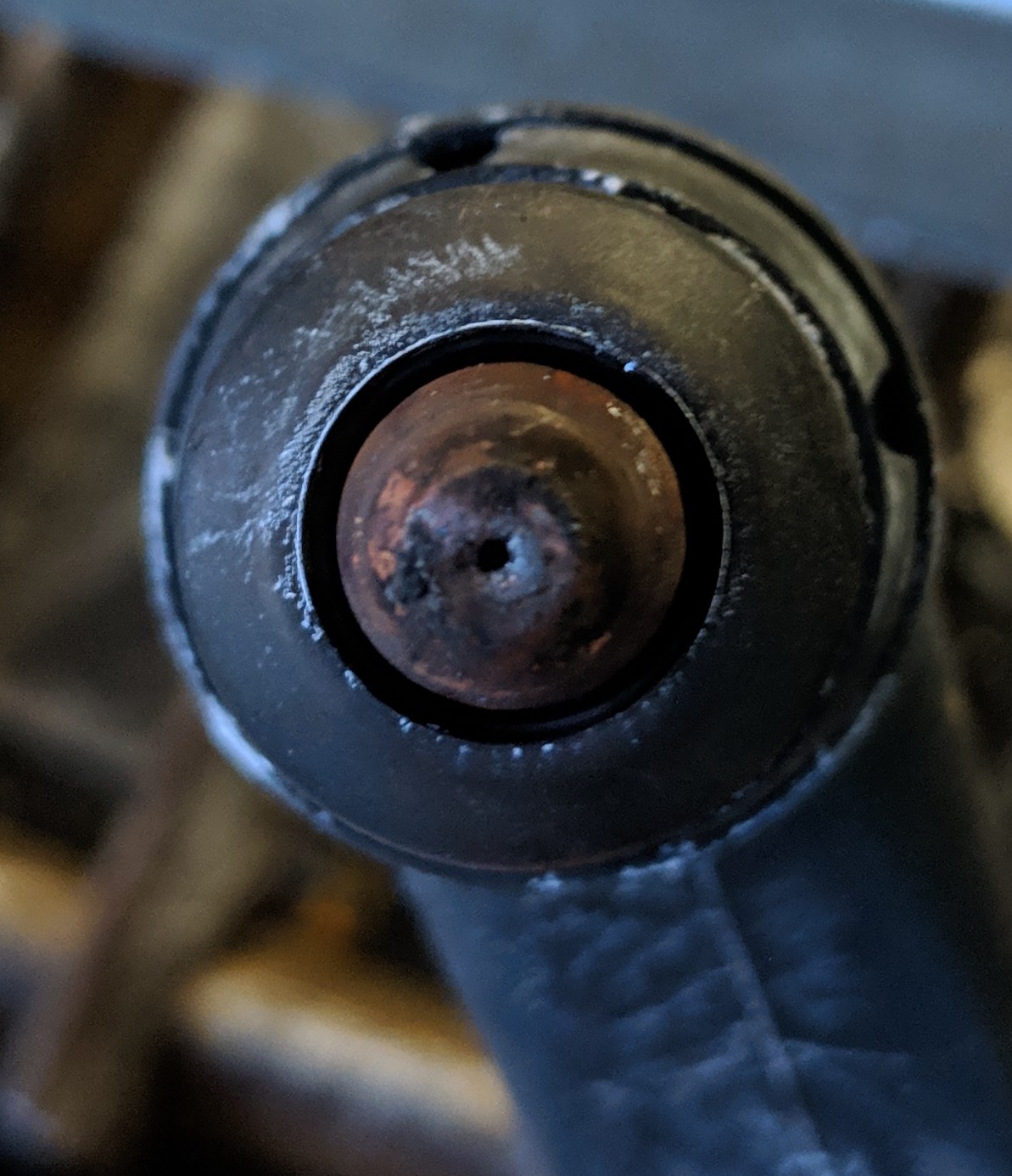
The gap between the cap and the tip is the air exit from the retaining cap.
It comes from here. Notice the holes on the swirl ring are outside the tip’s body. As are the grooves in the brass base. In fact if you look closely from inside the swirl ring you should see that the holes are actually angled back to front. That’s what causes the clockwise swirl of the arc gas.
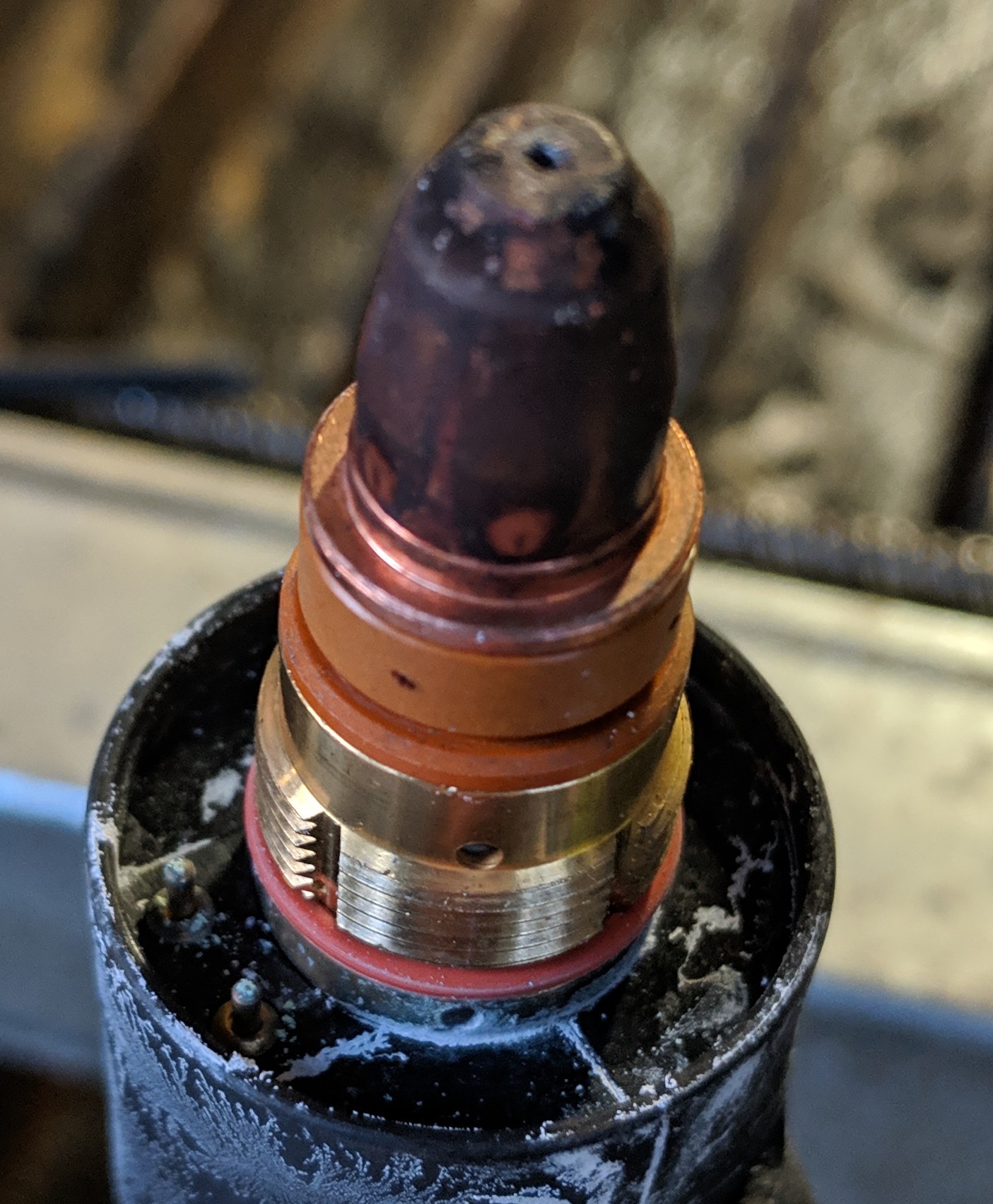
You can see the retaining cap has holes in the inside top to allow the air to exit through the gap in the first picture.
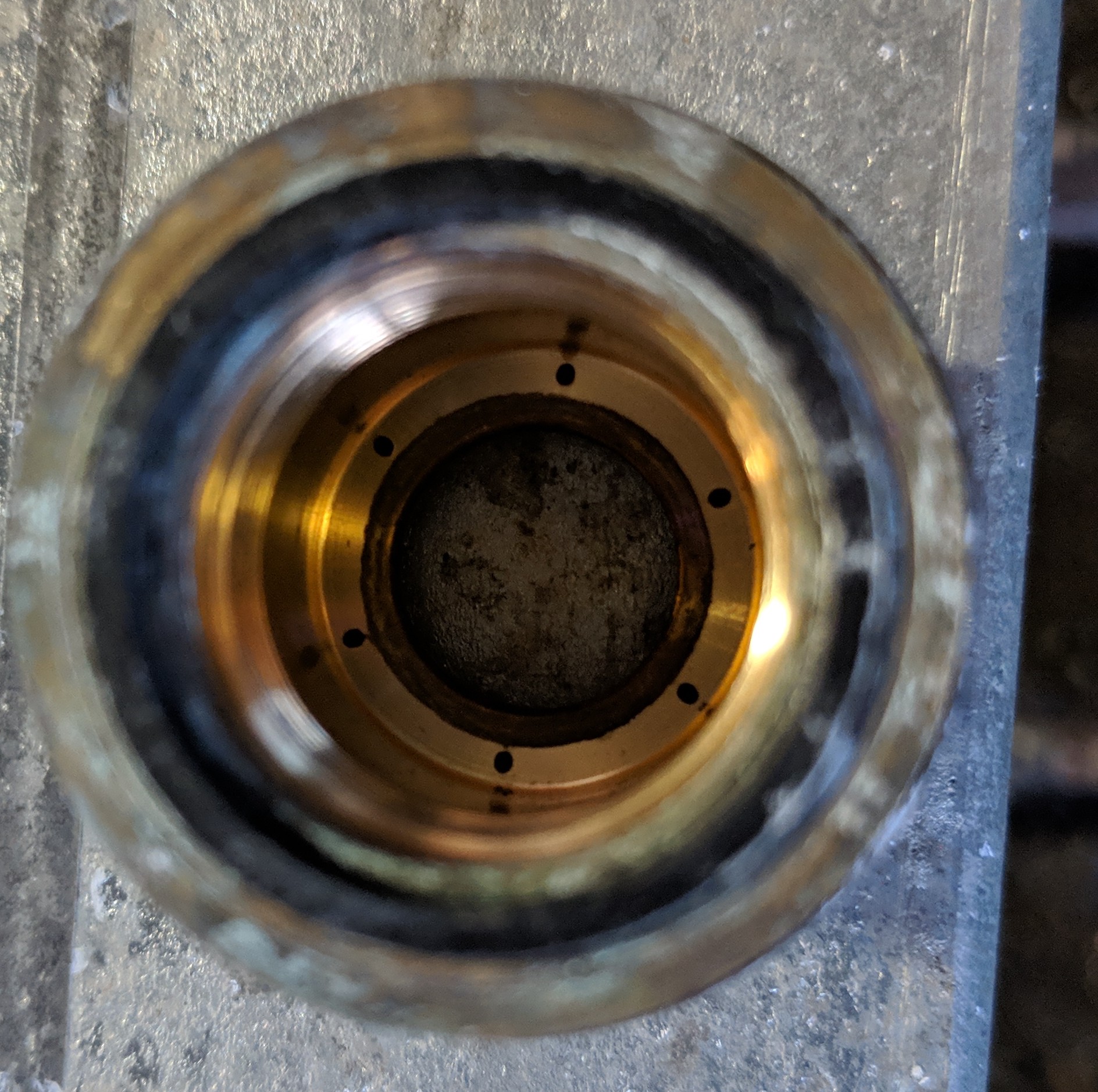
This is where the air comes from - note the gap at the base of the electrode. It actually opens up a bit when the retaining cap is screwed down - you can see that if you push down on the electrode there’s a larger gap.
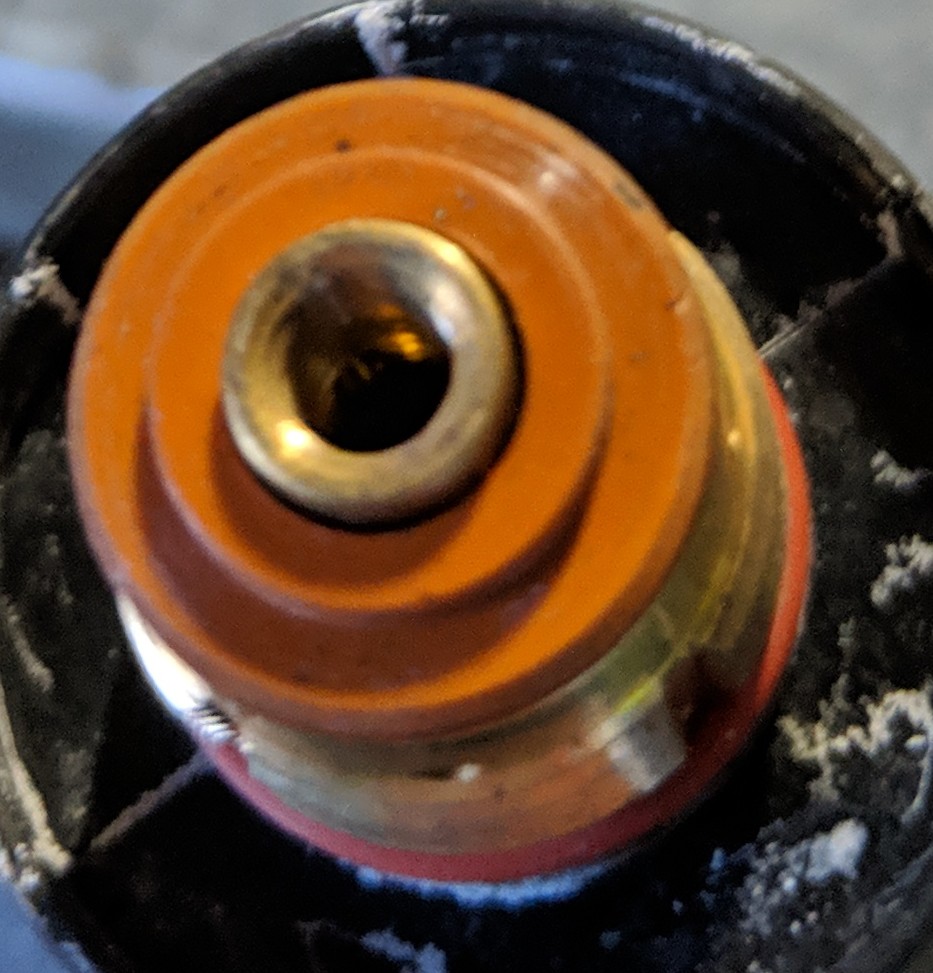
So that’s the air pathway I was suggesting is not affected by the nozzle size.
The air has to do that because that’s what creates the plasma arc and after the electrode cuts out provides the cooling air.
(Yeah, I know my torch could use some cleaning  The white residue is the washing soda evaporate from splashback from the water table and I could use a swipe of emery paper for the cap and nozzle. The electrode is fresh though.)
nice , high res pics. yeah i see what you mean. but it seems the shielding cap has considerably larger holes. anyway, just did some test cutting a few minutes ago. And there seemed to be little difference bringing up the pressure… So, the air consumption didnt change notably . I mean it wasnt like you used twice or 50% more air going from 50 psi to 70-75… I would say its less 10-20% difference, but i went back to the fine cut consumables. just from what I am seeing. So, regardless of PSI . I seem to get a larger benefit on air consumption based on nozzle size rather than psi. And in the end nozzle size seems to be relative to air consumption from my empirical real world experience.
Looking at the nozzle in the two pictures - how are they cutting? I would think this raggedness would affect the angle of plasma arc? are you still able to get an acceptable cut with a nozzle in the condition? because i would be changing this out a while ago// please advise./ perhaps i am changing too premature?